
Specification · v1.3
Measuring AI Agent Token Efficiency: The AEQ Spec
Agent Efficiency Quotient: Canonical Definition, Measurement Methodology, and Application Guidance
- Author
- Michael Valderrama | AI Agent Architect | Independent R&D (c) 2026
- Version
- v1.3,
Status Sections 1 to 8 are validated by controlled experiment (single-turn). Section 4 was amended in v1.2 on measured evidence; Sections 1 to 3 and 5 to 8 are unchanged from v1.0. Section 2.1 is definitional and Section 3.1 is non-normative related work. Section 9 (AEQ-L) is proposed, pending external validation.
Part of the AEQ framework, the measurement method behind the research papers.
1. Purpose and Scope
This document is the canonical specification for the Agent Efficiency Quotient (AEQ). It consolidates the definition, measurement methodology, and application guidance previously distributed across the AEQ experiment handoffs, the AgentSaaSy_EAM reference implementation, and associated whitepapers. Anything that cites AEQ, articles, evaluator prompts, client deliverables, production dashboards, should cite this document as the source of truth.
AEQ applies to AI agent systems: LLM-based systems that select tools, execute actions, and produce answers or outcomes. Version 1.0 fully specifies AEQ for single-turn agent interactions (one query -> one or more tool calls -> one answer), which is the validated case. Section 9 extends the framework to autonomous agent loops as a proposed variant.
2. Definition
AEQ = Business Value Delivered / Tokens ConsumedAEQ is an architecture quality metric, NOT a cost metric. It measures the signal-to-noise ratio of an agent architecture: what fraction of the model's capacity is doing useful work versus carrying architectural noise.
Two systems using the same model, answering the same query, can differ in efficiency by a factor of 4-5x purely on architecture (Section 8). AEQ makes that difference visible, measurable, and attributable to specific layers of the system.
2.1 Related Named Instruments, What AEQ Is Not
Two named instruments apply this framework. Neither is "AEQ," and neither redefines it. This section exists because the names have been conflated in derivative documents; where a conflict appears, this section governs.
- AEQ Grid is the certification program: a pre-registered experiment protocol that runs model × query-class cells against a locked pass bar, recording tokens, latency, and pass/fail per cell. It answers "is this model adequate for this workload class?", a question about a model-workload pair, not about an agent's architecture. AEQ Grid is a named application of the framework. Certification results cite their pre-registration document and emitted run report, not this specification alone.
- Agent_AEQ [PROPOSED] is the operator: an agent that ingests pre-registered workflow definitions, executes AEQ Grid on defined triggers (new workflow registration; model version change), and emits a static routing policy table for the execution layer. It is a design proposal; see ARCHITECTURE_NOTE_PreRegistered_Routing_2026-08-06 for its current specification and hypothesis flags.
Rule of use: the metric is cited as AEQ (this document). The certification program is cited as AEQ Grid (its pre-registration series). The operator, when built, is cited as Agent_AEQ. A sentence that needs one name to mean two of these is a sentence that needs rewriting.
3. Why Tokens Are the Denominator
Token prices fall continuously; a metric about token cost would depreciate with them. AEQ matters because three things do not get cheaper:
- Latency. Every wasted token takes time to process, and in agent workflows latency compounds across chained steps. A 2x token bloat in a 5-step chain is not 2x latency annoyance, it accumulates at every hop.
- Reliability. Bloated prompts degrade instruction-following accuracy. Long-context degradation is documented (Stanford/Berkeley, "Lost in the Middle"): models attend less reliably to material buried in noise. Prompt discipline is therefore an accuracy discipline, not a cost discipline.
- Context capacity. Context windows are finite. Every token consumed by architectural overhead is a token unavailable for tool outputs, conversation history, or reasoning room. Waste displaces work.
The bandwidth analogy: bandwidth got cheap, and performance engineering still mattered, because latency, congestion, and capacity planning never stopped being real. Tokens are following the same curve. Cheaper models won't save bad architecture.
3.1 Related Instruments, and Where They Disagree
Two published instruments measure the same tradeoff and both predate this specification. AEQ is not an alternative to either and should be read alongside them.
Cost-of-pass (Erol, El, Suzgun, Yuksekgonul and Zou, arXiv:2504.13359, April 2025, revised February 2026) formalizes the expected monetary cost of generating a correct solution, and a frontier cost-of-pass: the minimum of that across the available models or the approximate cost of hiring a human expert. The numerator is the move Section 9 makes for AEQ-L, a correct outcome rather than a token count. The denominator is the disagreement, and it is the subject of Section 3 above: cost-of-pass is denominated in dollars, so it reprices every time a vendor does.
Their headline conclusion also runs against this document's. They find that model-level innovations, not inference-time techniques, are the primary drivers of cost-efficiency improvement, where Section 8 attributes a 4.68x token difference to architecture with the model, query and answer all held constant. The two were measured on different questions: theirs compares models across benchmarks, and AEQ fixes the model and varies the architecture around it. They are not in direct contradiction. The tension is unresolved and no evidence in this specification settles it.
The Holistic Agent Leaderboard (Kapoor, Stroebl et al., arXiv:2510.11977, ICLR 2026) reports cost alongside accuracy as a default, across 21,730 agent rollouts on 9 models and 9 benchmarks for about $40,000, with 2.5 billion tokens of agent logs released for audit. Its Section 4.1 records a 9x cost difference for a two-percentage-point accuracy difference between two scaffolds on Online Mind2Web. That is the spread this specification exists to read, measured at a scale no single practitioner reaches. It is not a substitute for the equivalence rubric of Section 5: the pair compared varies the scaffold and the model together, so it bounds the combined spread rather than attributing it. Read as corroboration of magnitude, not of attribution.
4. The Three Efficiency Layers
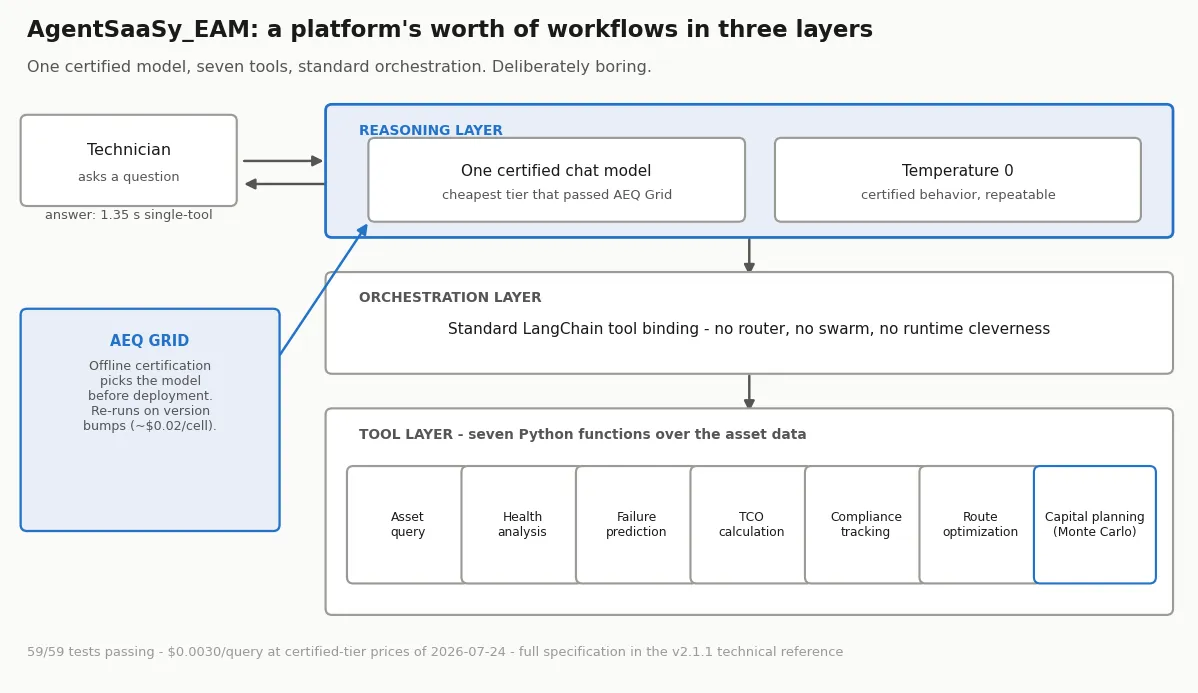
AEQ decomposes architectural waste into three independently addressable layers: orchestration can be fixed without changing the model, and the prompt can be fixed without changing the tools.
Addressable independently does not mean measurable independently. An intervention on one layer can move the measured value of another, and the effect has been observed running in both directions. Prompt bloat that carries redundant evidence can reduce output tokens, because context the model would otherwise have to derive is already present. Orchestration bloat multiplies output cost, because every additional model call pays whatever the model spends per call. On a reasoning-tier model these two effects moved two variants' totals in opposite directions in the same study (Blueberry, 2026-08-25, 180 measured cells under a pre-registration frozen before the first cell).
Consequence for reporting. AEQ is defined on total tokens. The three layers are diagnostics that locate waste and rank fixes; they are not addends that sum to the total, and a single layer read in isolation can rank two architectures the wrong way round. Report the total as the metric and the layers as attribution.
Layer 1, Prompt Efficiency
Definition: System prompt tokens as a share of total tokens consumed.
Measurement: Exact, via tokenizer on the prompt string before any API call:
import tiktoken
enc = tiktoken.encoding_for_model("gpt-4o-mini")
system_prompt_tokens = len(enc.encode(SYSTEM_PROMPT))
prompt_overhead_ratio = system_prompt_tokens / total_tokens
This measurement is reproducible and requires no API dependency. Prompt overhead is paid on every query, which makes it the layer with the most at stake: its waste multiplies by query volume.
Reference values (validated): optimized architecture 13.9%; severe bloat 29.4%.
Common anti-pattern: safety-by-verbosity, repeating role descriptions, redundant guardrail instructions, and describing every tool when the query needs one.
Layer 2, Orchestration Efficiency
Definition: Tool calls made relative to the minimum the query actually required.
Measurement: (a) count of tool calls vs. minimum necessary; (b) ratio of tool-output tokens vs. an optimized baseline, measured via tokenizer on sampled tool outputs. In the reference experiment: the query required 1 tool call; the bloated architecture forced 3.
Each unnecessary tool call adds input tokens (the call), output tokens (the result re-entering context), latency (a full round trip), and cost, with no added business value.
Common anti-pattern: forced multi-tool policies ("always use at least 3 tools for comprehensive analysis").
Layer 3, Output Efficiency
Definition: Response verbosity beyond what the answer requires.
Measurement: Output tokens vs. a capped baseline delivering equivalent content. Reference values: ~95 tokens (capped) vs. ~520 tokens (uncapped) for the same substantive answer, same conclusion, 5x the words. Those reference values come from a non-reasoning model and remain accurate for one.
Applicability. This layer assumes completion tokens are the response. On models that spend completion budget on reasoning the caller never sees, that assumption fails and output length stops tracking answer length. Measured 2026-08-25: a four-token answer behind 476 completion tokens, and 2,635 completion tokens spent to emit a single asset identifier.
Before reporting Layer 3 on such a model, establish which of three cases applies. If reasoning can be disabled and the workload still passes its equivalence rubric, measure Layer 3 with it disabled and say so. If disabling it costs equivalence, the reasoning is doing work rather than padding, its tokens are the price of the answer rather than waste, and Layer 3 should be reported with its spread across runs and no ranking drawn from it. If reasoning cannot be disabled at all, Layer 3 is not measurable on that model and is reported as withheld with the evidence, not estimated.
A fixed per-call overhead is not a safe correction. Measuring one and subtracting it was tried and rejected: the overhead was not fixed, ranging 66 to 2,547 tokens per call across ten queries on one model, and it correlated with prompt size, which is the variable architecture variants differ in. Subtracting it would bury a confound inside a corrected-looking number.
Common anti-pattern: no token budget in the prompt; the model is verbose by default and verbosity is mistaken for thoroughness.
5. The Numerator: Business Value and the Equivalence Rubric
"Business Value Delivered" is not scored on an absolute scale in v1.0. It is held constant via an equivalence rubric: two architectures are compared only when they deliver the same substantive answer.
An equivalence rubric must specify, before the experiment, the elements that constitute the answer. Reference rubric (the reference implementation): same critical asset count (12), same asset IDs cited, same actionable recommendation. Qualitative flag raised if conclusions diverge; diverging runs are not compared.
Design consequence: when value is held equal, the token delta between architectures is, by construction, pure architectural waste. This is what makes AEQ workable without solving general value quantification.
Known sacrifice: the rubric supports pairwise comparison, not absolute scoring. AEQ v1.0 answers "how much more efficient is architecture A than B at delivering this outcome," not "what is this system's standalone AEQ score." Absolute scoring is deferred (Section 11).
6. Measurement Protocol, Single-Turn (Validated)
The canonical experiment design, refined through independent critique (Cursor review, 8 issues resolved):
- Pin everything. Same model and version (e.g. gpt-4o-mini-2024-07-18), temperature 0, same query, same tool stubs. Pin pricing at publication time.
- Test a spectrum, not a binary. Minimum three architectures: Optimized (baseline), Moderate Bloat (realistic "good enough" implementations), Severe Bloat (extreme case, explicitly labeled as such). This defuses the straw-man objection.
- Measure inputs exactly. Tokenizer counts on prompt strings before API calls. Take output tokens from API usage fields; if simulated, label estimates as estimates.
- Run N ≥ 3 and average. Temperature 0 is deterministic but latency varies; failed runs are logged, not silently dropped.
- Apply the equivalence rubric (Section 5) before comparing. Capture full answer text for qualitative verification.
- Report per layer: prompt overhead ratio, tool calls vs. minimum, output tokens vs. cap, plus totals, cost, latency, and ratios vs. baseline.
- Publication integrity: always disclose which numbers are measured vs. estimated; validate simulation against real API calls before publishing.
7. Application as a Production KPI
In production, AEQ functions as the primary architecture-quality KPI:
- Baseline in Phase 1 of any deployment; monitor continuously through production.
- Track per agent. Different agents (advisor, diagnostic, orchestrator) have different legitimate token profiles; regressions are detected against each agent's own baseline.
- Dashboard placement: alongside SLA, error, and latency monitoring, not in the billing report. AEQ regression is an early-warning signal for reliability and latency degradation, not a cost alarm.
- Change gate: prompt registry changes, new tools, and orchestration changes should show AEQ impact before shipping (the prompt-registry/token-budget pattern in the reference implementation).
8. Validation Evidence (v1.0)
Controlled experiment, the reference implementation (enterprise asset management), gpt-4o-mini-2024-07-18, temperature 0, query: "What are the critical assets in the portfolio?", hybrid simulation (tiktoken-exact inputs, disclosed output estimates) with real-API validation within acceptable variance.
| Metric | Optimized | Moderate Bloat | Severe Bloat |
|---|---|---|---|
| System prompt tokens | 48 | 87 | 475 |
| Total tokens | 345 | 499 | 1,615 |
| Tool calls | 1 | 1 | 3 |
| Prompt overhead ratio | 13.9% | 17.4% | 29.4% |
| Token ratio vs. baseline | 1.0x | 1.45x | 4.68x |
| Cost ratio vs. baseline | 1.0x | 1.79x | 5.04x |
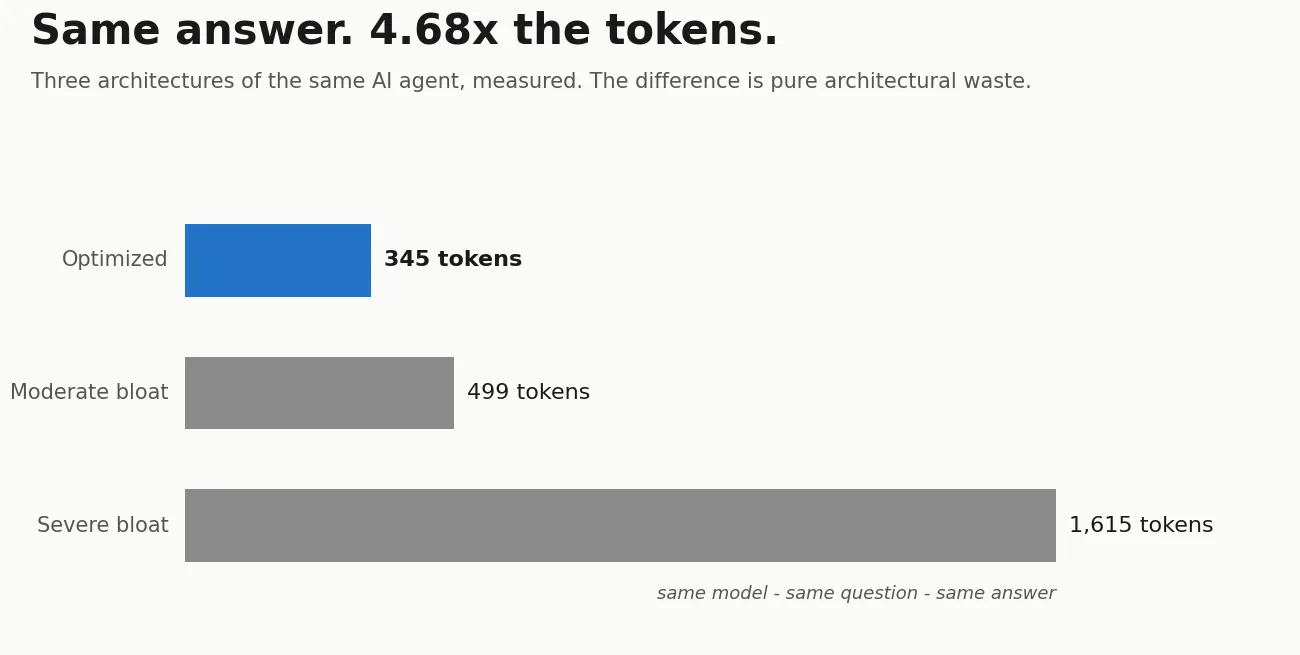
All three architectures delivered equivalent business value under the rubric. Same model, same query, different architecture: 4.68x token difference, 5.04x cost difference. Notable secondary finding: on simple queries the model chose the correct tool even under moderate bloat, the model compensates for bad prompts until orchestration is forced; in a forced multi-tool test, 3x cost and 3.6x latency for identical answers.
9. AEQ-L, Autonomous Loop Extension [PROPOSED, PENDING VALIDATION]
Status warning: Everything in this section is a design proposal. It has not been validated by experiment. External validation (Section 10) is in progress; this section will be revised to "validated" or amended in a future version based on results. Do not cite AEQ-L numbers as established findings.
Single-turn AEQ assumes the minimum necessary work is knowable in advance ("this query needs 1 tool call"). Autonomous agent loops, reason, act, observe, repeat until a stopping condition, break that assumption: minimum iteration count is generally unknowable a priori, context grows per cycle, and runs may end in a deliberate halt rather than an answer.
Proposed loop-native form:
AEQ-L = Successful Outcomes (including correct refusals) /
        Cumulative Tokens (all iterations, retries, and cleanup)
Design decisions embedded in this form:
- The numerator generalizes from "same answer" to "successful outcome." Loops produce trajectories, not answers; two valid runs may reach the goal by different paths. Outcome success replaces answer equivalence.
- A correct halt counts as value delivered. In gated loops ("refuse rather than lie"), a justified refusal spends tokens and produces no output, but it avoids the far larger downstream cost of acting on a hallucination (bad tool calls, wrong code, human cleanup). Canonical AEQ would score this as pure waste; AEQ-L scores it as value preserved. An incorrect halt (the run should have continued) scores as failure.
- The denominator is cumulative and honest. All iterations, all retries, and cleanup/rework tokens count. Architectures cannot hide waste in retries.
- The three layers persist, reinterpreted per iteration: Prompt Efficiency becomes per-iteration overhead × iteration count (overhead compounds every cycle, external memory vs. context re-stuffing is directly testable here); Orchestration Efficiency becomes redundant iterations, non-converging retries, and re-derivation of already-known state; Output Efficiency applies per iteration and to the final synthesis.
- Gate A/B testing: every control mechanism (routing tier, coherence gate, memory store) becomes tunable against one number, if adding the gate raises AEQ-L, it pays for its overhead; if not, the system is below break-even and simpler machinery wins.
Open questions deliberately deferred to validation: how outcome success is judged (binary goal-completion vs. milestone rubric vs. independent judge model); how halt-correctness is adjudicated; whether lucky fast convergence needs run-count normalization; how verification spend that buys reliability is distinguished from waste.
9.6 Fork-Gated Validation, Where Validation Lives in the Loop
In an agent loop, validation is not a stage, it is a function call and its call site is the decision fork. Wherever the loop branches (continue vs. halt, cheap tier vs. expensive tier, accept vs. retry, tool A vs. tool B), the fork invokes an external check and the check's verdict selects the branch. The fork and the validation are the same event: no fork, nothing to validate; every fork, a validation call site with a uniform shape, pause, call an external validator, branch on the verdict. The model never picks its own path unsupervised.
Routing gates and coherence gates in gated-loop architectures are both instances of this one pattern, asking different questions at different forks ("what tier does this need?" / "is this output grounded?").
Two economic rules follow:
- In-fork validators must be cheap. A fork's check is called every iteration, so its overhead is paid every cycle. Deterministic math, static rules, or at most a small model, placing a large LLM at every fork recreates the bloat problem AEQ exists to catch.
- Which forks get gated is itself a break-even decision. Gating a fork costs fixed overhead per call. Gate the forks where a wrong branch is expensive (acting on a hallucination; burning premium-tier tokens on mechanical work); leave ungated the forks where a wrong branch is cheap to catch downstream.
AEQ-L is the instrument that makes rule 2 empirical instead of a guess: A/B each fork's check (gate on vs. gate off) and keep it only if AEQ-L rises. This yields the layered architecture in one sentence:
Forks call validators, validators pick branches, AEQ validates the validators. Three layers, no self-grading anywhere.
AEQ never runs at the forks, it runs above them, measuring whether each fork's check earns the tokens it costs.
10. External Validation Requirements
AEQ results intended for publication or client decisions must satisfy the independence rule:
- Cross-model independence. The evaluating/validating model must be from a different model family than the model(s) inside the system under test. A model never grades a framework as applied to itself. (Rationale is the same research the industry uses to justify external gating: LLM self-correction is unreliable, Huang et al. ICLR 2024.)
- Model-independent measurements first. Tokenizer counts, call counts, iteration counts, gate decisions, and latency are model-independent by construction and carry the evidentiary weight. Model-dependent judgments (value equivalence, outcome success, halt correctness) are where independence matters most.
- Tokenizer normalization. When systems under test and validators use different tokenizers, report counts in the system-under-test's native tokenizer and disclose the tokenizer used for every figure.
- Reproducibility. Prefer validators whose behavior can be pinned: fixed model version, temperature 0, N ≥ 3 runs, verdict-stability check. Local open-weights validators (pinned weights + checksummed prompt + manifest) provide the strongest reproducibility claim.
- Two-family verdicts. For published claims, obtain verdicts from at least two independent model families. Divergence between independent evaluators is itself a reportable finding, not an inconvenience.
Standard instruments: the AEQ External Validation Prompt (generic template) and filled instances per target project.
11. Known Limitations and v1.2 Roadmap
Deliberately out of scope, in priority order:
- Absolute AEQ scoring. v1.x is pairwise-comparative. An absolute scale requires a value-quantification method that survives cross-domain comparison, not yet specified.
- Target thresholds. No "good AEQ" number is defined. Reference values (Section 4) are anchors, not thresholds. Thresholds should emerge from production baselines across deployments.
- AEQ-L validation. Section 9 graduates from proposed to validated (or is amended) based on external evaluator results and at least one instrumented loop experiment.
- Formal latency/reliability weighting. v1.x treats latency and reliability as consequences of token waste, reported alongside AEQ. Whether they enter the formula as weights is an open design question.
- Multi-agent attribution. How AEQ decomposes across orchestrator/worker agent teams sharing a task. (The swarm coordination-overhead experiment in ARCHITECTURE_NOTE_PreRegistered_Routing_2026-08-06 §7 is the designated instrument.)
12. Version History
| Version | Date | Changes |
|---|---|---|
| 1.0 | July 2026 | First canonical spec. Consolidates experiment handoffs v1–v2, whitepaper definitions, and validation protocol. Adds AEQ-L as proposed extension, including §9.6 Fork-Gated Validation (fork = validation call site; forks call validators, validators pick branches, AEQ validates the validators). |
| 1.1 | August 2026 | Adds §2.1 Related Named Instruments: AEQ Grid (certification program) and Agent_AEQ (proposed operator) formally named as distinct applications of the framework, the metric, the program, and the operator are three names for three jobs. Resolves the naming collision identified 2026-07-28. §11.5 cross-references the swarm coordination experiment. No changes to validated Sections 1–8. First in-repo copy of the canonical spec. Archived PDF of this version, superseded by 1.2 below: AEQ_Specification_v1.1.pdf. |
| 1.2 | August 2026 | First change to validated Section 4. The layers are stated as independently addressable but not independently measurable, with the cross-layer interaction measured in both directions (Blueberry showcase, 2026-08-25, 180 cells across two arms). Layer 3 gains an applicability note for reasoning-tier models, where completion tokens are not the response. AEQ remains defined on total tokens; the layers are attribution, not addends. Evidence scope is one model, one workload, eight queries where value was held constant: enough to retire a universal claim of independence, not enough to establish a general magnitude. Sections 1-3 and 5-8 unchanged. |
| 1.3 | October 2026 | Adds non-normative Section 3.1 Related Instruments, situating AEQ against cost-of-pass (Erol et al., arXiv:2504.13359) and the Holistic Agent Leaderboard (Kapoor et al., arXiv:2510.11977, ICLR 2026), including where cost-of-pass's attribution of cost-efficiency gains to model-level innovation runs against Section 8's attribution to architecture. No change to any validated section, to the definition, or to the measurement procedure. |
Michael Valderrama | AI Agent Architect | Independent R&D (c) 2026 | github.com/ibucketbranch/AgentSaasy | medium.com/@michael_valderrama
Measured against this specification
- Same Model, Same Answers, Up to 2.91x the Tokens A pre-registered run of the AEQ method: one model across three agent architectures, reasoning on and off, including the arm where the layers disagreed.